New in XMLSpy 2027

Version 2027 of the XML and JSON Editor was announced on October 29, 2026. Learn about all the new features and update to the latest version.

XMLSpy® 2027 (October 29, 2026)EnterpriseProfessional
Support for Open API 3.2
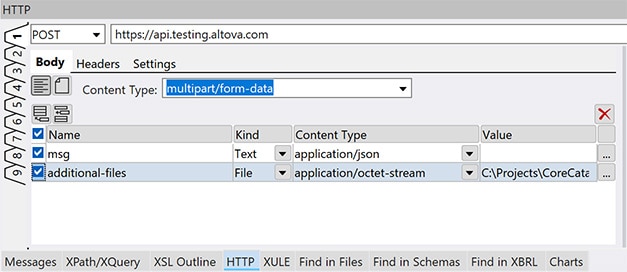
Support for multipart/form-data POST requests
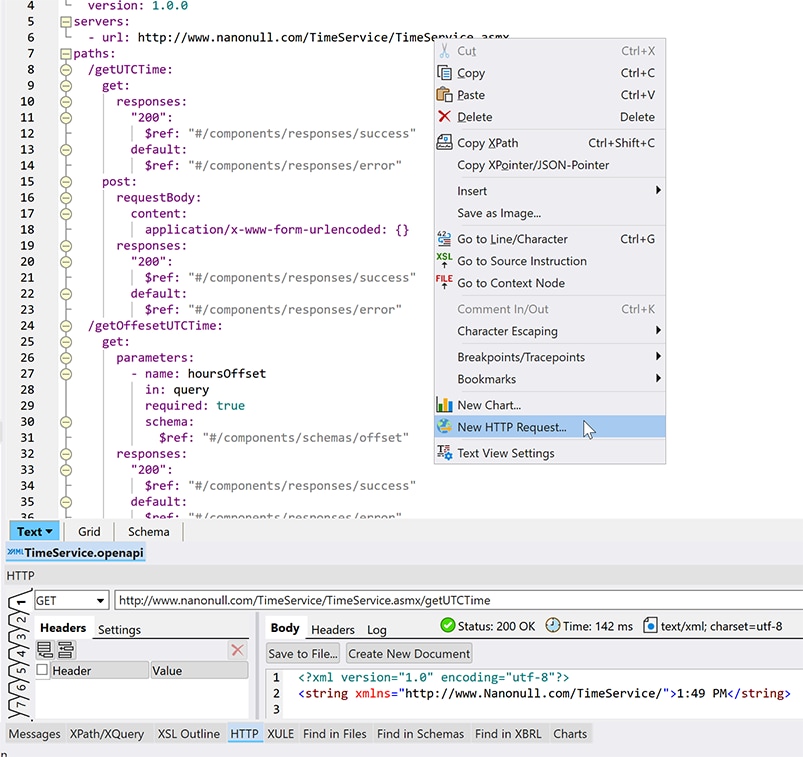
Ability to create HTTP request from current OpenAPI file
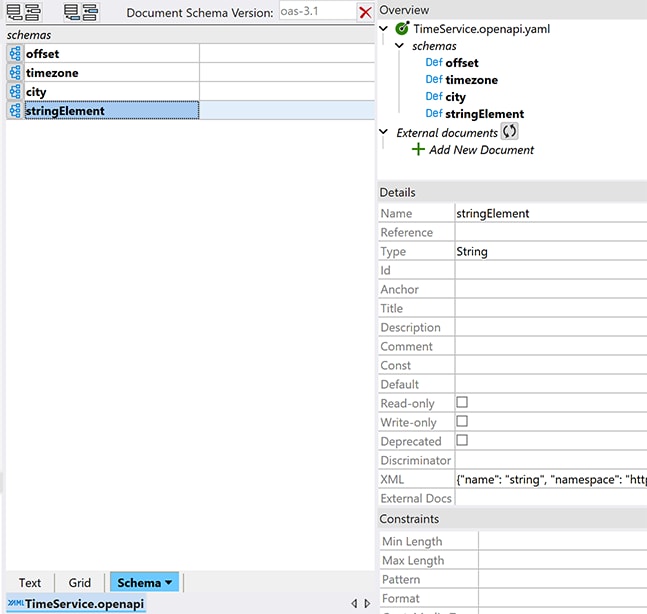
Ability to edit an XML Schema embedded in an OpenAPI file
Validation & sample generation for selected JSON Schema definition
Validation & sample generation for JSON Schema in OpenAPI files
New setting for one-click file activation in Project window
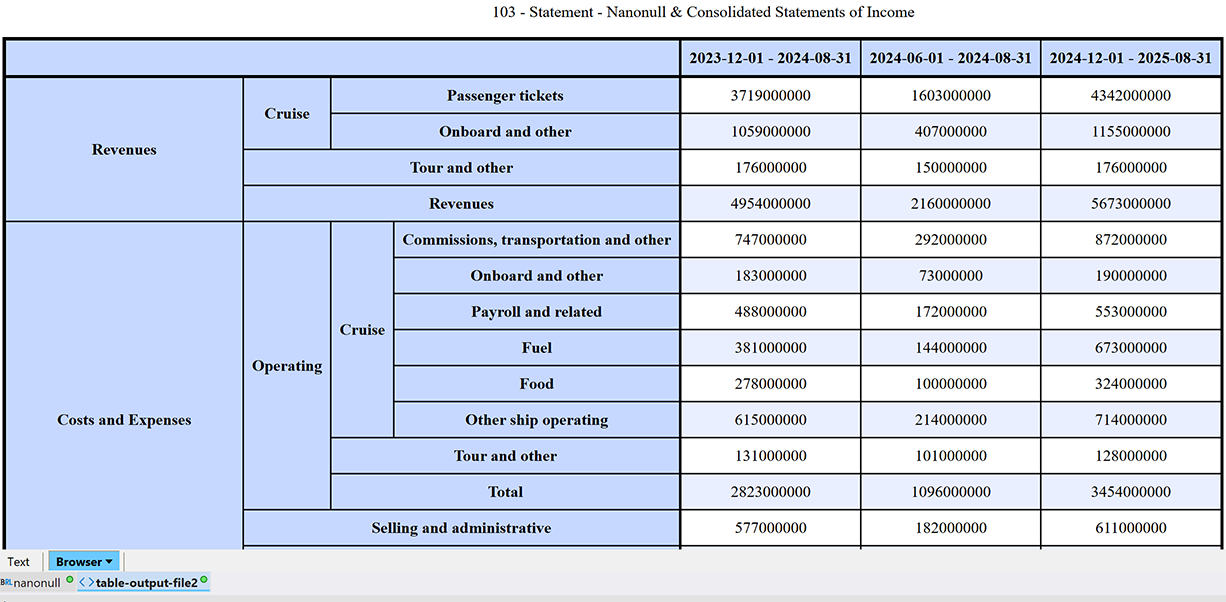
Support for XBRL Table rendering from CSV files
Support for XBRL-CSV Table Constraints 1.0
Support for SQL Server 2025
Support for Oracle 26
Support for Informix 15
Support for MySQL 9.7
Support for SQLite 3.53
Support for MariaDB 12
Support for Eclipse 4.40 (2026-06) and 4.41 (2026-09)

Support for OpenAPI 3.2

XMLSpy includes multiple tools for editing, testing, and validating OpenAPI documents and requests. Support has been updated to cover the latest version of the OpenAPI standard in addition to older versions.

Support for multipart/form-data POST requests

The HTTP Testing Window in XMLSpy now supports sending multipart/form-data POST and PUT requests. This content type is the standard way web APIs accept file uploads and requests that combine several kinds of data, such as text fields, JSON, and binary files, in a single message. Each part of the request carries its own name, headers, and content type, which makes it more flexible than a simple key-value form submission.

The HTTP Testing Window now includes entry helpers for building a multipart request. For each part, you specify a name, choose whether it is a text value or a file, set its content type, and then enter the text or select the file to upload.

You can add as many parts as the API expects, so uploading multiple files in one request, or sending a file together with its JSON metadata, is now a matter of filling in a few rows in the HTTP Testing Window.

multipart form-data testing

The OpenAPI wizard has also been updated to handle this content type. When you generate a test request from an OpenAPI definition whose operation declares a multipart/form-data request body, XMLSpy reads the schema for that operation and pre-populates the form part editor with the expected parts, including their names and types. You can then fill in values and file paths, send the request, and inspect the response in the same window, exactly as with any other request type.

The HTTP Testing Window now covers the full range of requests a typical API accepts, from JSON bodies and simple forms to file uploads and mixed-content requests. Build the request by hand or generate it from your OpenAPI definition, then send it and inspect the response, all in one window.

Ability to create HTTP request from current OpenAPI file

When working in an OpenAPI file, you can now right-click any operation and generate an HTTP request for it. XMLSpy reads the path, method, parameters, and request body from the surrounding definition and opens a ready-to-send request in the HTTP Testing Window, so you can test an endpoint without leaving the file or re-entering its details.

Create HTTP request from current OpenAPI document

Ability to edit a schema embedded in an OpenAPI file

When an OpenAPI document contains schemas, they can now be viewed and edited directly in the graphical XMLSpy JSON Schema Editor. Simply toggle to Schema view while working on an OpenAPI document and the schemas will be listed.

Edit schema in OpenAPI doc

Clicking the schema icon next to a schema in the list opens its graphical detail view.

Validation & sample generation for selected JSON Schema definition

In addition to validating a JSON instance against a complete JSON Schema, or generating a sample from one, you can now select a single definition within the schema and use it to validate a JSON instance or generate a sample.

This is useful when you're working with a fragment of a larger document, such as an API request body, a single record, or a config block, that maps to one definition rather than the full schema.

Validation & sample generation for JSON Schema in OpenAPI files

OpenAPI documents typically define the structure of request and response bodies as JSON Schema, either inline or under components/schemas. You can now select any of these schema definitions directly in an OpenAPI document and use it to validate a JSON instance or generate a sample. This lets you check a request payload or produce a realistic sample response without extracting the schema into a separate file.

New setting for one-click file activation in Project window

A new option offers single-click file activation in the Project window. After enabling this in the on the Project tab in the Tools/Options menu, you can click a file once to open it, or to bring it to the front if it's already open. It's a fast way to move between files in large projects, matching the workflow used in other modern editors and IDEs.

Support for XBRL Table rendering from CSV files

XMLSpy supports OIM 1.0, including validation and conversion of xBRL-CSV reports. Now it can also render human-readable tables as XML or HTML directly from xBRL-CSV documents, just as it does for XML-based XBRL files.

Human-friendly rendering of xBRL-CSV table

Updated database support

XMLSpy 2027 now supports the latest versions of multiple databases:

  • SQL Server 2025
  • Oracle 26
  • Informix 15
  • MySQL 9.7
  • SQLite 3.53
  • MariaDB 12

Updated Eclipse support

XMLSpy supports seamless integration in the Eclipse IDE with new support added for the latest versions:

  • 4.40 (2026-06)
  • 4.41 (2020-09
Update
Existing customers may update to the latest version here
Download
Download a fully functional, free 30 day trial of any Altova product now!
New in MobileTogether
New features for cross-platform, native app development in
MobileTogether

New Features in Previous Versions

Learn about all the additional capabilities you’ll get by upgrading from an older version to XMLSpy Version 2027.

XMLSpy® 2026r2 (May 27, 2026)EnterpriseProfessional
Altova AI for XML development
Support for Taxonomy Packages in Altova XBRL Taxonomy Manager
Updated XBRL-CSV Table Constraints 1.0 support
Support for PostgreSQL 18
Support for Eclipse 4.38 & 4.39
XMLSpy® 2026 (October 21, 2025)EnterpriseProfessional
BSON Editor
Editing XBRL Taxonomy Packages
Support for XBRL-CSV Table Constraints 1.0
Support for Firebird 5.0
Support MariaDB 11.4 and 11.8
Support for PostgreSQL 17
Support for Visual Studio 2026 Insiders
Support for Eclipse 4.34, 4.35, 4.36, 4.37
Support for Windows Server 2025
XMLSpy® 2025 (October 22, 2024)EnterpriseProfessional
YAML Grid View
Extended YAML support in Text View
YAML schema support
Support for Open API extensions in JSON Schema Editor
EBA XBRL data quality checks
Find & Replace in ZIP archives
Support for MySQL 8.4
Support for MariaDB 10.11, 11.2, and 11.4
Support for Eclipse 4.30, 4.31, 4.32, 4.33
Support for video links in Projects
XMLSpy® 2024r2 (April 23, 2024)EnterpriseProfessional
YAML support
Support for assigning prepackaged schemas to XML instances files
Support for XBRL Report Packages 1.0
Code generation for .NET 8
Support for MySQL 8.2 & 8.3, PostgreSQL 16, MariaDB 11.2, SQLite 3.45
XMLSpy® 2024 (October 24, 2023)EnterpriseProfessional
AI Assistant
Support for editing Markdown files
Improved support for large files in Grid View
Ability to save/load HTTP requests
Native support for MySQL and MariaDB
Updated support for OIM XBRL
Support for XBRL Calculations 1.1
Integration with Eclipse 2023-06 and 2023-09
Saving schema diagrams as SVG
Support for horizontal mouse wheel scrolling
XMLSpy® 2023r2 (April 12, 2023)EnterpriseProfessional
Horizontal or vertical split in Grid View
Option to create new document from XPath/XQuery results
Support for Firebird 4, PostgreSQL 15, SQL Server 2022
Integration with Eclipse 4.26, 4.27
XMLSpy® 2023 (October 19, 2022)EnterpriseProfessional
Altova XML Schema Manager
Dark and Light modes
Reporting checks for ESEF XBRL
Snappy codec support for Avro
Support for Microsoft Edge in Browser View
Support for additional database versions
Integration with Eclipse 4.23, 4.24, 4.25
XMLSpy® 2022r2 (March 8, 2022)EnterpriseProfessional
Improved conversion from XML Schema to JSON Schema
Setting for maximum nesting levels during XML sample generation
Ability to save images/files in editing views
New toolbar in Project Window
Support for images in Project Window
Support for a <default> file type
Code generation for Visual Studio 2022 and .NET 6
Support for XBRL Assertion Severity 2.0
Support for additional database versions
Integration with Visual Studio 2022
Integration with Eclipse 4.22
XMLSpy® 2022 (October 27, 2021)EnterpriseProfessional
Support for Windows 11
New exit mode options
Significant performance improvements in new XML Grid View
Sticky header when scrolling in Grid View
Whitespace indicators in Grid View
New options to preserve whitespace when pretty-printing
Support for BSON (binary JSON) in JSON Schema
Saving expressions directly in XPath/XQuery window
Support for OIM 1.0 for XBRL
Extended support for some XBRL Taxonomies
Settings to configure XBRL validation message limits/traces
Support for additional database versions
Support for Eclipse 4.19, 4.20, and 4.21
XMLSpy® 2021r3 (June 1, 2021)EnterpriseProfessional
Support for JSON Schema versions 2019-09, 2020-12
XMLSpy® 2021r2 (March 4, 2021)EnterpriseProfessional
Completely new XML Grid View
C# code generation for .NET Core and .NET 5
Updated support for IBM DB2 for iSeries
Integration with Eclipse 4.17 and 4.18
XMLSpy® 2021 (October 14, 2020)EnterpriseProfessional
XBRL Taxonomy Manager
COVID-19 related XBRL taxonomy updates
Multiple improvements to JSON Grid View
Support for JSON $id
New Altova extension functions to retrieve schema-related info
Updated support for MariaDB
Integration with Eclipse 4.15 and 4.16
XMLSpy® 2020r2 (March 17, 2020)EnterpriseProfessional
Validation on edit
Auto-backup of documents during editing
Improvements to XPath Debugger
New namespace options in generated code (C++, C#, Java)
Support for X3D files
Support for additional database versions
Integration with Eclipse 4.13 and 4.14
XMLSpy® 2020 (October 9, 2019)EnterpriseProfessional
All new JSON Grid Editor
Chart creation from JSON data
Support for JSON Lines and JSON Comments
New JSON pretty print options
XULE support
Multiple improvements to XPath/XQuery tab
Code generation for Visual Studio 2019
Integration with Visual Studio 2019 and Eclipse 4.11, 4.12
Support for additional database versions
XMLSpy® 2019 Release 3 (April 2, 2019)EnterpriseProfessional
Split Text View
Support for JSON Schema draft-06 and draft-07
Support for additional database versions
Updated Open JDK support
Support for Office 2019 (OOXML)
Support for Windows Server 2019
Support for Eclipse 4.9 and 4.10
XMLSpy® 2019 (October 17, 2018)EnterpriseProfessional
XMLSpy is going sharp! All new support for high-PPI monitors
Support for additional database versions
Support for XBRL Generic Preferred Label 1.0
Removal of duplicate XBRL facts
New entry helpers for XBRL Typed Domain
Support for US-GAAP 2018
Support for Eclipse 4.8
XMLSpy® 2018r2 (April 17, 2018)EnterpriseProfessional
Processing JSON with XSLT, XPath, and XQuery
HTTP Testing Window supports importing from WSDL
Syntax coloring for new file types
XBRL Certified Software™ designation from XBRL International
Support for editing XSLT3 value templates
Support for Teradata 16 and MariaDB 10 databases
Detailed network proxy settings
Ability to cancel lengthy execution during XSLT/XQuery debugging
XMLSpy® 2018 (October 3, 2017)EnterpriseProfessional
New HTTP testing window
3-way XML diff/merge
Significant improvements in XSLT engine
Improved spec conformance in XSLT/XQuery engine
Support for xsl:output methods ‘adaptive’ and ‘json’
Redesigned Tools/Options dialog
Support for XBRL Versioning 1.0
Support for XML Signatures 1.1
Code generation support for Visual Studio 2013, 2015, 2017
Integration with Eclipse 4.7
Support for Sybase 16, PostgreSQL 9.6, MySQL 5.7
Support for FOP 2.2
XMLSpy® 2017 Release 3 (April 4, 2017)EnterpriseProfessional
XSLT and XQuery back-mapping
Support for JSON5
Support by JSON Schema extensions for Microsoft Azure Resource Manager
Find bar supports multi-line searches
Display of validation errors and SmartFix suggestions in left margin in Text View
Support for signing with SHA-256
XPath expression syntax coloring in XSLT stylesheets
Numerous new features in charting engine
Ability to cancel lengthy XSLT/XQuery transformations
Support for XBRL Extensible Enumerations 1.1
Integration with Visual Studio 2017
Windows Server 2016 support
XMLSpy® 2017 (October 4, 2016)EnterpriseProfessional
All-new Find functionality in Text View
Text highlighting of related matches
New command to jump to parent element in Text View
Editing and validation of Apache Avro schema files
Special Grid View for Viewing/Searching Apache Avro binary files
New XSLT/XQuery features
XSLT and XQuery performance improvements
Support for XBRL Taxonomy Packages
Support for Inline XBRL
Support for ADO.NET database drivers
Native support for PostgreSQL
Support for Progress OpenEdge databases
Support for SQL Server 2016
Editing headers/footers in dynamic HTML and CALS tables
Support for integration with Eclipse 4.6
XMLSpy® 2016 Release 2 (February 16, 2016)EnterpriseProfessional
XPath and XQuery Debugger
New Layout Options for XPath/XQuery Window
Conversion between XML Schemas and JSON Schemas
JSON instance generation from JSON Schema
Generation of JSON Schema documentation
Enhancements to Text View: better folding, synchronized tag editing, and more
Support for additional XSLT 3.0 instructions
Support for XBRL Assertion Severity 1.0
Integration with Eclipse 4.5
XMLSpy® 2016 (September 30, 2015)EnterpriseProfessional
JSON Schema editor and validator
Generation of JSON Schema from JSON instance
JSON instance validation and entry helpers based on JSON Schema
Mass XML to JSON converter for large numbers of files
Executing XSLT & XQuery transformations on installed RaptorXML Servers
High performance JSON validation via installed RaptorXML Server
Windows 10 support
Support for Firebird databases
Support for numerous databases updated to include newest versions: IBM DB2 10.5, SQL Server 2014, PostgreSQL 9.4, MySQL 5.6, and Oracle 12C
Visual Studio integration updated to include VS 2015
XMLSpy® 2015 Release 3 (February 25, 2015)EnterpriseProfessional
Support for XPath 3.1 and XQuery 3.1
Significantly extended XPath/XQuery tab
Support for Web Services Security and other security extensions
Support for XBRL Extensible Enumerations 1.0
Support for custom fonts in Output Windows
XMLSpy® 2015 (September 17, 2014)EnterpriseProfessional
Intelligent XML file modification with XQuery Update Facility 1.0/3.0 - convenient window lets users intelligently update XML instances
Support for XQuery Update Facility via XQuery execution (Alt+F10)
Enhanced XSLT 3.0 support - including support for xsl:assert and automatic tail recursion detection for xsl:call-template
XBRL Table Layout preview - graphical view allows real-time table preview during editing
Building XBRL Formulas visually, via new XBRL Table Preview - for point-and-click XBRL Formula creation
Support for US GAAP taxonomy updated to include 2014
Significantly optimized support for EBA 2.1 (COREP/FINREP) taxonomies - larger files validate much faster
Inclusion of UBL 2.1 Schemas - these now ship with the product
Support for Eclipse 4.4
XMLSpy® 2014 Release 2 (March 19, 2014)EnterpriseProfessional
XSL Speed Optimizer
Large number of new Altova extension functions
Additional support for XSLT 3.0
Completed support for XQuery 3.0
XBRL Table Linkbase editor
New commands for XBRL Formula execution and XBRL Table generation
Ability to provide custom error text for XML Schema assertions
Support for integration with Visual Studio 2013 (adds to support for previous versions)
XMLSpy® 2014 (October 29, 2013)EnterpriseProfessional
XML Schema 1.1 support - full support for validation and graphical editing
Support for XPath 3.0 - including intelligent XPath autocompletion
Support for XSLT 3.0 - for XSLT editing, debugging, and profiling
Support for XQuery 3.0 - for XQuery editing, debugging, and profiling
Support for XBRL Formula and XBRL Concept Types
Ability to display multiple validation errors at once - based on user configuration
Support for new databases: SQL Server 2012; PostgreSQL 9.0.10, 9.1.6, 9.2.1; IBM DB2 9.5, 9.7, 10.1; Informix 11.70; MySQL 5.5.28; Sybase ASE 15, 15.7; Access 2010, 2013
Integration with Eclipse 4.3 - the latest version of this popular IDE
Ability to generate sample XML instances with all schema choices
XMLSpy® 2013 Release 2 (April 29, 2013)EnterpriseProfessional
FOP 1.1 support
XMLSpy® 2013 SP1 (November 15, 2012)EnterpriseProfessional
Support for Windows 8
Support for Windows Server 2012
Support for Internet Explorer 10 (in desktop mode)
Visual Studio integration now includes Visual Studio 2012
XMLSpy® 2013 (September 15, 2012)EnterpriseProfessional
Smart Fix: automatic correction of validation errors
Seamless integration options in Java applications
Support for embedded XML Schemas in WSDL files
Enhanced WSDL documentation options
Flexible integration of external programs
Support for CamelCase words in spell checker
Option to strip unnecessary whitespace
Integration with Eclipse 4.2 (adds to support for earlier versions)
Support for US GAAP 2012 XBRL taxonomy (adds to support for earlier versions)
Support for Team Foundation Server MSSCCI Provider 2010 for version control systems
XMLSpy® 2012 Release 2 (February 23, 2012)EnterpriseProfessional
EPUB 2.x support - editing, validating, and previewing EPUB documents for creating e-books and digital publications
Zip and OOXML support extended to Professional Edition - support previously only available in XMLSpy Enterprise Edition
Support for logical files in IBM iSeries databases - enhances database integration by supporting logical files, which are specific to IBM iSeries
Ability to escape/unescape XML characters - easy command for escaping/unescaping characters to be included as text/XML
Faster start-up - XMLSpy now launches in almost half the time previously required
XMLSpy® 2012 (October 19, 2011)EnterpriseProfessional
HTML5 support - adds to support for editing HTML4 & XHTML with context sensitive entry helpers, code completion, etc.
CSS3 support - editing support for this most recent version of the stylesheet language
JDBC database driver support - adds to support for ODBC and ADO
New Java API - completely new, native Java API for automating XMLSpy functionality (a COM API is also available)
New samples for API use - codes samples showing how to utilize the XMLSpy APIs in your preferred environment
Find in project - easily locate files in large or complex XMLSpy Projects
XMLSpy® 2011 Release 3 (June 8, 2011)EnterpriseProfessional
Digital signatures for XML documents - adds security measures to XML file transmission
PXF support in Authentic view - enables truly portable XML forms
Support for .NET 4.0 scripting - updates support to include latest .NET version
Ability to add additional .NET assemblies for scripting - easily add assemblies in addition to those provided by default
New spell checker with improved dictionary support - provides support for more languages & language peculiarities
Support for Internet Explorer® 9 in Browser View - support updated to include latest version from Microsoft®
Shortcut for selecting entire XML element - ctrl-shift-e
XMLSpy® 2011 Release 2 (February 16, 2011)EnterpriseProfessional
Embedding external files in XML - embed external files, e.g., images, directly in XML documents
Customizable documentation generation - customize XSD, WSDL, or XBRL documentation generation via StyleVision templates
Enhancements to chart creation functionality - candlestick charts, chart overlays, background images, and more
Sorting of elements and types in schema view - sort some or all schema components alphabetically with one click
Refactoring support for XML Schemas - easily locate and rename all instances of a global element/type across referenced schemas
Intelligent support for changing element types and base types - preserve compatible facets when changing the type of an existing element or base type
XMLSpy® 2011 (September 8, 2010)EnterpriseProfessional
Chart creation - instant generation of eye-catching charts to display numeric XML data
Validation of SOAP messages against WSDL files - validates SOAP messages against SOAP spec, and associated WSDL definition, including referenced XML Schemas
Schema Flattener - writes all the dependent files that are included in a schema into one file
Schema Subset Creation - creates a smaller schema from a subset of selected elements and types
XMLSpy® 2010 Release 3 (May 10, 2010)EnterpriseProfessional
Ability to validate naming and coding conventions - allows for validation of naming and coding conventions outside of the capabilities of XML Schema
User-defined sample values for XML instance generation - enables users to add arbitrary sample data for truly randomized XML instance generation
Support for Visual Studio 2010
XMLSpy® 2010 Release 2 (February 16, 2010)EnterpriseProfessional
64-bit version - for use with 64-bit operating systems
Optimizations for working with large files - optimizations for loading very large files in Text View and speed increases for common operations (e.g., paste) in Grid View
XML Schema-based validation up to 3 times faster in Text View
SharePoint® Server support - allows reading and writing to SharePoint Server with full checkout / undo checkout / check-in capabilities
HTTPS support for SOAP requests & SOAP debugging - HTTPS is now supported for SOAP request creation and SOAP debugging
Support for Linux in generated C++ code - Autogenerated C++ code may be compiled and run on Linux
XMLSpy® 2010 (October 28, 2009)EnterpriseProfessional
WSDL 2.0 editing and conversion - allows you to choose which version to work with or even convert from 1.1 to 2.0
XBRL documentation generation - autogenerate comprehensive XBRL documentation in HTML, RTF, or Word
XBRL Taxonomy Wizard - an easy-to-understand way to get a jump start creating a new extension taxonomy
Printing graphical XBRL View - prints the graphical XBRL representation as displayed in XBRL View
Find in XBRL, XBRL sorting - helpful tools to locate XBRL elements and organize/navigate large files
JSON editor - edit JSON files in Text View or Grid View
JSON <=> XML conversion - easily convert between JSON and XML files when building Web 2.0 applications
New scripting environment and forms editor - multiple enhancements for creating forms, event handlers, macros, and more
Compatibility with Windows 7
XMLSpy® 2009 (February 3, 2009)EnterpriseProfessional
Support for XBRL 2.1 and XBRL Dimensions 1.0 - lets you view, edit, and validate XBRL documents
XBRL Taxonomy Editor - allows you to view, extend, and edit XBRL taxonomies in a graphical view with intelligent XBRL taxonomy editing functionality
XPath auto-completion - provides valid XPath functions, as well as element and attribute names from the associated schema and XML instance(s) when composing XPath expressions
Native support for additional databases - including PostgreSQL 8, SQL Server 2008, Oracle 11g
Expanded source control system support - provides enhanced support for a large variety of popular source control and versioning systems
Extensions for identity constraints editing in Schema View - provides enhanced visual cues and options for editing identity constraints in XML Schema view
Support for the XSLT extension altova:evaluate - new function that takes an XPath expression as its argument and returns the output of the evaluated expression
Support for Apache FOP 0.95 - for performing XSL:FO transformations
XMLSpy® 2008 Release 2 (April 28, 2008)EnterpriseProfessional
Very large file support - allows you to open and work with files that are about 4-5 times larger than those supported in the past*
Detailed find & replace in XML Schema editor - allows you to perform detailed find and replace operations within single schemas and across complex multi-file schemas with ease
Enhanced XSLT details in Info Window - for viewing and configuring information such as instance and schema associations, quickly organizing related files into projects and ZIP archives, and more
New XSL Outline entry helper window - provides information about templates and functions in XSLT stylesheets that can be searched, navigated, sorted, modified, and more
Support for Java, C#, JavaScript, and VBScript in XSLT 1.0/2.0 engines - allows editing, debugging, and profiling of advanced stylesheets that contain these types of program code
Support for SOAP 1.2 - adds to existing support for SOAP 1.1 in the WSDL editor, SOAP client, and SOAP debugger
Project generation for Visual Studio 2008 - when generating C++ or C# code
Visual Studio integration extended to include Visual Studio 2008 - adds to support for previous versions
XMLSpy® 2008 (September 12, 2007)EnterpriseProfessional
Support for working with XML in Microsoft PowerPoint 2007 files – allows users to open PPTX files, edit the data, add new files and folders, remove files, and so on.
Data editing support in the Database Query window – now allows users to edit database data inside the window, then commit changes back to the database.
Support for XPath evaluation in multiple files – supports calculating the results of XPath expressions across multiple files simultaneously.
Support for XInclude and XPointer – allows users to easily build large XML instances from multiple smaller documents.
Two-step XSL:FO transformation – allows developers to complete XSL:FO transformations from XML to PDF in two steps, enabling the use of more advanced XSLT engines.
One-click comment in/out – allows users to easily add and remove comments using the right-click menu.
Entry helpers in text and grid views extended to include annotations
Speed and memory enhancements
XMLSpy® 2007 Release 3 (May 30, 2007)EnterpriseProfessional
Support for working with XML data in Microsoft Office 2007 files and other zipped archives – XMLSpy can now extract, edit, and transform XML data saved in the Open XML standard used by Microsoft Office 2007.
A new database query window – allowing users to easily connect to all major databases, view the structure of their databases, and query them from within XMLSpy using SQL or SQL/XML.
Executing XQuery documents against databases (currently IBM DB2) – allowing users to query XML content in DB2 9 accurately, efficiently, and on a granular level.
Support for IBM’s DB2 XQuery extensions – deep integration with IBM DB2 pureXML provides the optimal XML / data server solution for accessing, utilizing, and storing XML content.
XML Schema registration in IBM DB2 databases – for DB2 validation of XML data in database columns.
Enhanced XML Schema documentation – with the ability to save files in rich text format (RTF) and create diagrams in enhanced meta-file (EMF) format – a vector graphics format with enhanced zooming and printing capabilities.
Enhanced WSDL documentation – extending the functionality listed above for XML Schema documentation to WSDL documentation.
Comprehensive CSS editing support – a full featured CSS editor with syntax coloring, context-sensitive entry helper windows and drop-down menus, and screen tips.
Redesigned and optimized code generation
Support for XSLT 1.0 profiling (adds to XSLT 2.0 and XQuery support)
Extended OASIS catalog support
XMLSpy® 2007 (October 24, 2006)EnterpriseProfessional
A completely redesigned graphical WSDL editor – making it even easier to design WSDL documents graphically, using drag and drop functionality and helpful context-sensitive entry-helper windows and menus.
Performance optimizations – including a 50% reduction in the memory footprint required for validation and doubled speed when loading and parsing files. These optimizations will make your work in XMLSpy even faster and more efficient.
Dynamic new XPath Analyzer window that stores multiple expressions and results – instead of a dialog that has to be opened and closed, the XPath Analyzer is displayed in a window that is always available while you’re working.
Find-in-files window with support for find & replace across multiple files and projects – you can run case-sensitive searches on partial or whole words or search using regular expressions. Search results are displayed for each file with line and column numbers, and clicking on any individual search result opens the associated file with the search item highlighted.
Support for January 23, 2007 XSLT 2.0, XPath 2.0, and XQuery standards – providing numerous advanced capabilities to transform, access, and query XML data in a standardized and interoperable manner. Altova previously supported draft versions of the specifications.
Improved generation of XML instances from XML Schemas / DTDs and vice versa
Tighter Visual Studio integration
Support for embedding XMLSpy in your applications via ActiveX control
Enhanced Eclipse integration, supporting Eclipse SDK 3.2
XMLSpy® 2006 Release 3 (June 1, 2006)EnterpriseProfessional
New XSLT 2.0 and XQuery Profilers – monitors XSLT 2.0 or XQuery code as it runs and records how long each process takes. Developers can promptly see which parts of the code take the longest time to process and optimize it more easily by focusing on problem areas. Helps create more efficient and robust XSLT and XQuery code quickly. Profilers are Enterprise Edition only.
Enhanced Error Handling – presenting detailed messages about each error in a new validation window, including hyperlinks to errors and relevant troubleshooting information. Makes project management and problem resolution considerably faster and more effective.
Introduced tracepoints in XSLT debugger – allowing you to trace the output of any instruction node to verify that your XSLT code is producing the desired output. This feature helps developers perfect their XSLT code more efficiently than ever before.
Improved Restriction Handling for XML Schema Development – simplifying the process of deriving by restriction to create new complex types. The XMLSpy graphical schema editor makes the process easier and prevents users from creating illegal or invalid restrictions.
XMLSpy® 2006 (October 3, 2005)EnterpriseProfessional
Enhanced Standards Support – updated XSLT 2.0, XPath 2.0, and XQuery support in compliance with the latest World Wide Web Consortium (W3C) Working Drafts released on September 15, 2005.
Introduced schema-awareness in XSLT 2.0 and XQuery Engines – allowing developers to harness the full power of XSLT 2.0 and XQuery in their applications by providing mechanisms for error isolation, simplified debugging, increased functionality, and enhanced code performance.
Updated Microsoft® Visual Studio®.NET Integration – provides full integration with the Visual Studio.NET 2005, giving developers access to all of XMLSpy’s advanced features and views directly from within the Visual Studio.NET 2005 development environment.
Updated Eclipse Integration – enables full integration with version 3.1 of the Eclipse development environment, allowing seamless access to all XMLSpy features and views directly from within Eclipse 3.1.
XMLSpy® 2005 (October 3, 2004)EnterpriseProfessional
Advanced Standards Compliance – provided unsurpassed compliance with, and validation against current industry standards, making it one of the most conformant DTD/Schema implementations available.
XSLT 2.0 Support – offers full editing, visual transformation, stylesheet design, and debugging capabilities of the powerful new XSLT 2.0 standard for transforming and formatting XML content.
XPath 2.0 Support – facilitates building, testing, and evaluating of XPath 2.0 expressions, which are used for locating and processing content within an XML document’s logical hierarchy.
XQuery Support – delivered native support of the new XQuery 1.0 specification for extracting information from XML documents and databases. Development, editing, debugging, and execution capabilities are all provided.
SchemaAgent – embodied a compelling new paradigm for modeling and managing complex schemas and their components in workgroups via a powerful, client/server-based, visual tool.
Introduced Eclipse Integration – enabled full integration with the then-current version of the Eclipse application development environment, allowing seamless access to all XMLSpy® 2005 features and views directly from within Eclipse.
XSLT 2.0, XPath 2.0, and XQuery 1.0 support – with these important specifications, developers can write less complex and convoluted code, thereby reducing errors and increasing productivity. Furthermore, increased programming functionality and strong data typing enable greater data processing capabilities and contributing significantly to improved code quality and reusability.
XMLSpy® 2004 Release 4 (May 17, 2004)EnterpriseProfessional
Introduced new advanced text view – provides context-sensitive entry helpers, line numbering, book marking, source folding, indentation guides, detailed find and replace functionality, and significantly increased performance.
Extended database import/export functionality – interacts directly with the most popular relational databases, including Microsoft Access, SQL Server, Oracle, MySQL, Sybase, and IBM DB2.
Improved XML-aware file differencing and merging – enables the user to intelligently compare the XML content, considering variations in formatting, namespaces, attribute order, etc., and then merge the selected changes.
XMLSpy® 2004 Release 3 (October 28, 2003)EnterpriseProfessional
Visual Studio – improved integration with Microsoft's Visual Studio versions 2002 and 2003.
Enhanced Options for XML Differencing – allowing specification of file extensions for directory compare.
Improved Schema Editor – displays the model of a redefined XML schema complex type.
Further support for XPath 2.0 – additional functionality implemented to support then-current W3C Working Draft.
XMLSpy® 2004 (September 2, 2003)EnterpriseProfessional
Microsoft Visual Studio® .NET® Integration – introduced an added convenience, enabling Microsoft Developers to use XMLSpy directly within their preferred editing environment.
XML Differencing – introduced visual comparison of files and directories in a highly configurable, XML-aware manner, taking into account namespaces and other variables.
XPath 2.0 Analyzer – supported a then-current beta implementation of the W3C's XPath 2.0 working draft of May, 2003.
Completely re-implemented Database Utilities – introduced native support for Oracle databases, auto-generation of Microsoft SQL Server and Oracle 9i XML Schema extensions, and generation of XML Schemas according to SQL/XML standard.
XMLSpy® 5 Release 4 (April 7, 2003)EnterpriseProfessional
Enhanced WebDAV Support – introduced support for DeltaV, an extension to the WebDAV protocol which enables check-in/check-out functionality when used in conjunction with a WebDAV server, thus allowing users to collaboratively edit and manage XML files located on remote web-servers.
Stylesheet Designer Enhancements – introduced support for direct usage of global templates, support for conditional statements in Stylesheet Designer, as well as support for PDF Header/Footer/Cover pages, thus allowing for more customized template layouts and content outputs. These capabilities are now found in StyleVision and MissionKit.
Enhanced Code Generation – introduced support for output code which uses Xerces (a popular XML parser), Standard Template Library (STL), and additional support of XML Schema simple types in Java/C# code generation.
XMLSpy® 5 Release 3 (January 22, 2003)EnterpriseProfessional
Improved Support for building Microsoft .NET applications – introduced support for Microsoft C# code generation to accelerate application development on the Microsoft .NET platform. The generated code used System.XML, the then-current Microsoft .NET Application Program Interface (API) for programmatically accessing XML documents.
Enhanced support for Oracle XML DB – introduced numerous data editing and server administration features for Oracle XML DB. New features enabled developers to easily perform common operations on data managed by XML DB including: List XML Schemas, Load a Schema from a list, Save New or Delete XML Schema to Oracle XML DB, Register an XML Schema with Oracle XML DB, Execute Query using Oracle9i's DBURI, Browse, Open, Edit and Save XML documents stored in Oracle XML DB via WebDAV.
Additional Web Services Support – a new Web Service Description Language (WSDL) Documentation generation utility made it easier for Web service developers to document and publish a Web service interface in a Microsoft Word or HTML output file.
PDF support for Document Publishing – XMLSpy's stylesheet designer introduced visual editing and generation of eXtensible Stylesheet Language Formatting Object (XSL:FO) code, enabling XML content to be rendered into PDF file format. With a single stylesheet design, developers could preview the output of a stylesheet transformation in either PDF or HTML.
Java Integration Support – introduced a Java API, enabling easier customization and integration of the XMLSpy development environment for system integrators who want to control and use XMLSpy functionality from Java-based programs. XMLSpy previously supported integration via a COM based interface.
XMLSpy® 5 (September 16, 2002)EnterpriseProfessional
XSLT Debugging – introduced a built-in XSLT debugger, allowing developers to incrementally step through an XSLT transformation process and set breakpoints on either the XSLT stylesheet or the XML input document, inspect variables, check the call stack, analyze node-sets, and more.
WSDL Editing – XMLSpy® 5 Enterprise Edition introduced a new Web Service Description Language (WSDL) editor, allowing users to edit, visualize, and validate WSDL files.
Code Generation – XMLSpy® 5 Enterprise Edition introduced Java and C++ code generation capabilities, enabling XMLSpy to act as a software modeling and prototyping tool. Built-in code generation frees software developers from the mundane tasks of writing low level infrastructure code, accelerating project development.
XMLSpy® 4.4 (May 29, 2002)EnterpriseProfessional
DocBook Editing Support – introduced support for CALS and HTML tables, enabling DocBook editing. DocBook is the popular XML content model for describing books, articles, and other prose documents such as technical documentation.
Web Standards Conformance – with then-current open industry consortiums such as the Web Services Interoperability Organization.
Multi-language spell-checker – with support for English (British, US, Canadian), German, Italian, Portuguese, Spanish, French, Dutch, Swedish, and other languages. In addition, separate English language medical and legal dictionaries were introduced.
XMLSpy® 4.3 (February 11, 2002)EnterpriseProfessional
Introduced World’s First SOAP Debugger – test and debug web services based on Simple Object Access Protocol (SOAP).
Supported Microsoft SQL Server 2000 SQLXML – graphical editing of XML Schemas which use Microsoft SQLXML schema extensions.
XMLSpy® 4.2 (December 10, 2001)EnterpriseProfessional
Supported then-current XML technologies, including Simple Object Access Protocol (SOAP).
Introduced support for Microsoft XML parser technologies (MSXML4).
Update
Existing customers may update to the latest version here
Download
Download a fully functional, free 30 day trial of any Altova product now!