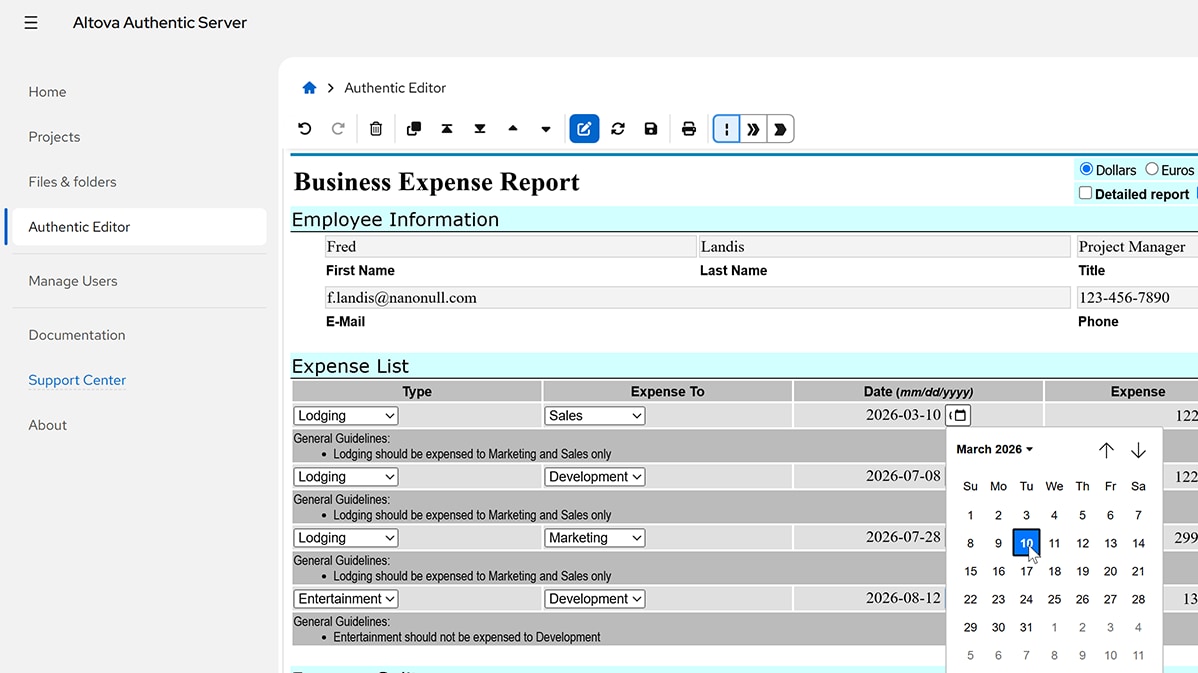
Authentic Server brings Authentic's WYSIWYG XML editing to users across your organization in any web browser.
Authentic Server lets business users edit XML documents in a familiar, forms-based view directly in their web browser, with centralized control over editing and sharing. Available for Windows and Linux machines, Authentic Server can be deployed on-premises or in the cloud.
Organizations keep their most important content in XML for good reason. Technical manuals, product documentation, contracts, sales reports, and reference material often need to be published in several formats, reused across many documents, kept consistent over years of revisions, and checked for completeness before they go out the door. XML makes all of that possible. The challenge is that the people who know the content best rarely want to work with XML markup.
Altova Authentic has long given non-technical business users a way to work with XML content without being exposed to the underlying technology. Content appears in an easy-to-read electronic form, users type and edit as they would in any word processor, and Authentic produces valid XML behind the scenes.
Authentic Server brings that same user-friendly editing experience to the web. Instead of installing software on each user's machine, you install Authentic Server once, and users connect from Chrome, Edge, Safari, Firefox, or their browser of choice on any device. It's the easiest way deploy structured content authoring to the people who actually write the content: technical writers, subject matter experts, editors, and reviewers.
Authentic Server presents XML documents as clean, human-readable forms. Users see headings, paragraphs, tables, charts, and fields, not markup, and every change they make is validated against the underlying schema as they type. XML content authoring features include:
The editing forms users see in Authentic Server are designed in Altova StyleVision, the same visual design tool used for Authentic Desktop. Designers define how content is displayed, which fields are editable, and what rules apply, all within a visual, drag-and-drop design environment. Functionality includes:
|
Design once, deploy everywhere | Build an editing template in StyleVision and publish it to Authentic Server for any user you grant access. |
|
Business logic with XPath | Add auto-calculations, conditional display, and custom validation rules directly in the template design. |
|
Dynamic forms | Show or hide sections, change layouts, or adjust available options based on user input. |
|
Reuse existing designs | Templates already built for Authentic Desktop can be deployed on Authentic Server. |
The Authentic Server administrator controls who can see and edit what from a central web interface:
Once installed, Authentic Server runs as a service on your server. The administrator uploads templates designed in StyleVision, configures users and permissions, and shares the server URL. Users open that URL in their browser, sign in, and start editing. There are no plug-ins to install and nothing to update on individual workstations. When you update a template on the server, every user sees the change on their next visit.
Authentic server is available for:
Install Authentic Server wherever it fits your infrastructure and security requirements.
Authentic Server and Authentic Desktop share the same editing experience and the same StyleVision templates, so you can choose the deployment that fits each team. Authentic Desktop is installed on client machines and supports editing XML documents as well as content stored in SQL databases. Authentic Server delivers browser-based XML document editing to users anywhere, with no installation. Many organizations will use both: Authentic Desktop for power users and database-backed forms, Authentic Server for broad, low-friction access to XML content authoring.