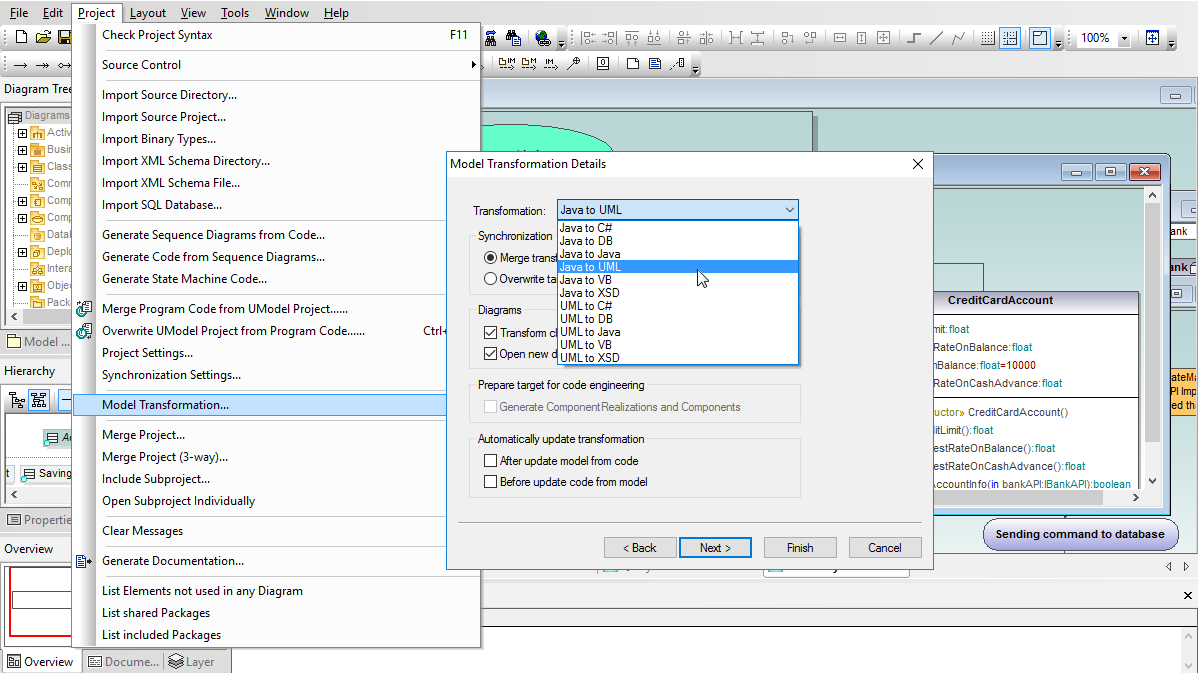
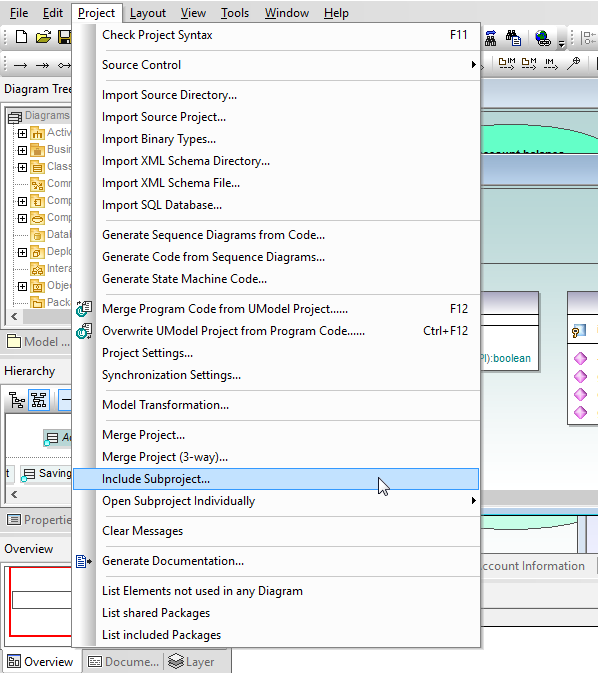
Model Driven ArchitectureUModel® 2012 supports Model Driven Architecture (MDA) through platform-independent models and a Model Transformation selection in the Project menu that transforms all code relevant modeling elements to and from C#, Visual Basic, Java, databases, and XSD. Platform Independent ModelsModel Driven Architecture is a set of standards and methods for applying the UML (Unified Modeling Language) administered by the Object Management Group. In Model Driven Architecture, the UML model of a software project is a platform independent model (PIM) that can be fully described without concern for the details of any specific programming language. This development strategy allows software architects and other developers to focus exclusively on logic required by the subject domain, rather than characteristics of any programming language. Altova UModel Features OverviewAltova UModel® 2012 is an intuitive, affordable, and fully featured tool to create UML use cases, and to enjoy all the additional advantages of UML-based software development. UModel supports these advanced features:
Model TransformationA Model Driven Architecture approach to software engineering with platform independent models provides two primary advantages:
Model Transformation can even be applied to projects that are reverse engineered from existing source code. For instance, an existing Java application can be reverse-engineered by UModel then transformed to generate Visual Basic classes, and many other possibilities are available. Data Type MappingDuring model transformation, UModel maps data types from the source to the target to accommodate differences between languages. The Type Mapping dialog lets you review or even edit type mapping pairs.
UModel also automatically adds the target language profile to the transformed project. UML Class DiagramsAs part of the model transformation, new UML classes and class diagrams are created for the target, reflecting classes and class diagrams in your original UModel project. The screen shot below shows the Hierarchy of Account diagram for Visual Basic after model transformation from Java. The new Account class in the new folder named VB Target in the model tree contains Visual Basic syntax for all properties and operations. For instance, the new balance property is defined as the Visual Basic Single data type, whereas in Java the data type was float. After transformation, the original Account class for Java is preserved in the model in its original location in the model tree. The original UML design for Java will now generate code in multiple source code languages – Java and Visual Basic.
Persistent Transformation ParametersThe transformation paradigm extends to updating existing transformations and merging the updates into the specified target models. Transformation parameters are stored in a Model Transformation Profile in the model. The Transformation Profile can be set to run transformations automatically before forward engineering code generation, and/or after reverse engineering, to update elements for one target language based on changes to model elements for another.
These Transformation Profile settings can also be changed at any time.
This functionality lets UModel automate much of the maintenance of multiple source code languages as your cross-platform model evolves. Find out for yourself how Model Driven Architecture and model transformation with UModel® 2012 can accelerate your development projects. Download a free 30-day trial today! |
| |||||||||||||||||||||||
| Company | Legal | Press | Partners | Careers | Sitemap | Contact Us | Altova Blog | Mobile | Full Site | |||
|