XSL:FO for PDFAltova StyleVision® 2012 includes the world's first visual XSL:FO designer to automate the writing of PDF documents through an intuitive, drag-and-drop user interface. Presenting data from XML applications, XBRL financial reports, and relational databases in PDF format is a common requirement in report generation and document management systems. Writing intricate XSL:FO stylesheets for performing these transformations is easy with the robust visual editing capabilities of StyleVision. In addition, that same design simultaneously produces an Authentic eForm, as well as HTML, RTF, and Word 2007+ (OOXML) output and the associated XSLT stylesheets.
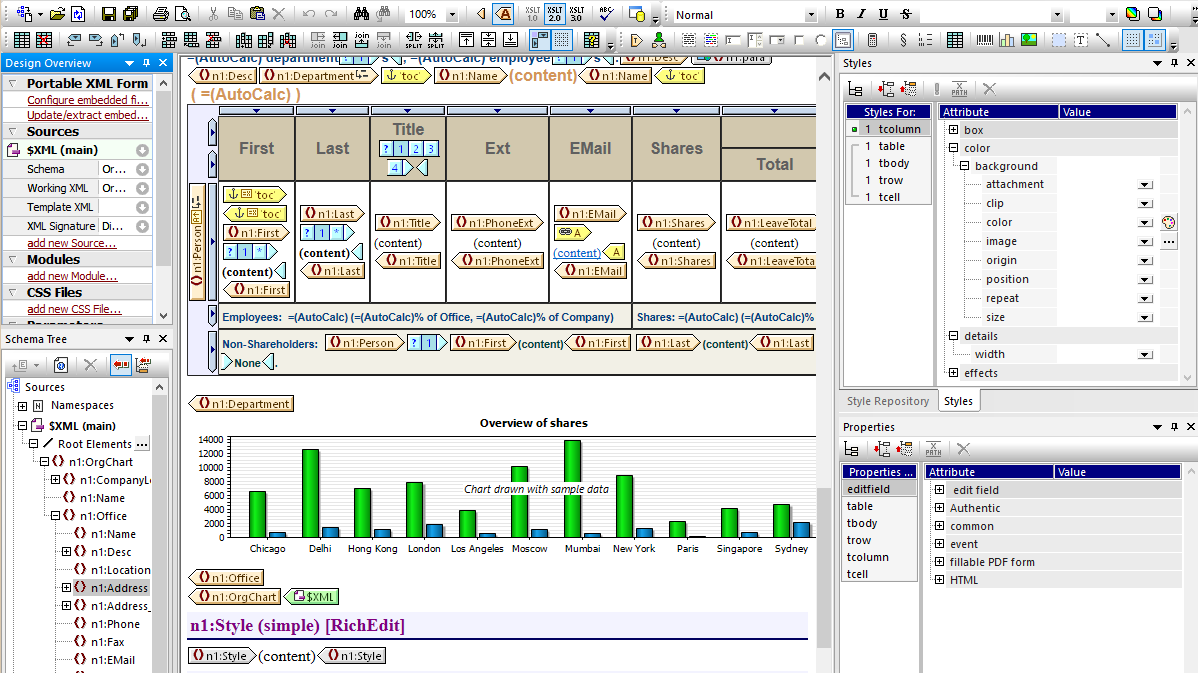
Visual XSL:FO Design for PDFsThe unique StyleVision approach to XSL:FO design makes creating presentation stylesheets easier and faster than ever before. The intuitive visual design process means you don’t need prior XSL:FO, XPath, or template coding experience to design PDF output in StyleVision. To begin creating an XSL:FO stylesheet, simply open an existing XML Schema, XML instance, DTD, XBRL taxonomy, or database in StyleVision, and the content model will appear in the Schema Tree entry helper. You can even connect to multiple XML and database schemas to incorporate data from multiple sources – such as an XML file and a database – in your design. When you select an element or attribute that you wish to see in your PDF output and drag it from the Schema Tree window onto the design pane, StyleVision prompts you to specify how you would like the new node to be handled (for example, as a new paragraph, image, table, etc.). This information will be rendered dynamically based on the data in your source(s). You can also insert static content such as header text, images, hyperlinks, and so on.
The StyleVision interface provides advanced entry helper windows for viewing, editing, and assigning the style and layout properties of each element or document section in your design. Learn more about this functionality on the Stylesheet Design page. Since PDF documents are paginated, they require specific styling considerations. StyleVision includes special XSL:FO options for formatting PDF documents, including cover page design options, page numbering, page count totals, headers and footers, margins, etc. These options are available in Document Section properties entry helper windows. Other XSL:FO-specific options are also accessible in the Styles entry helper window.
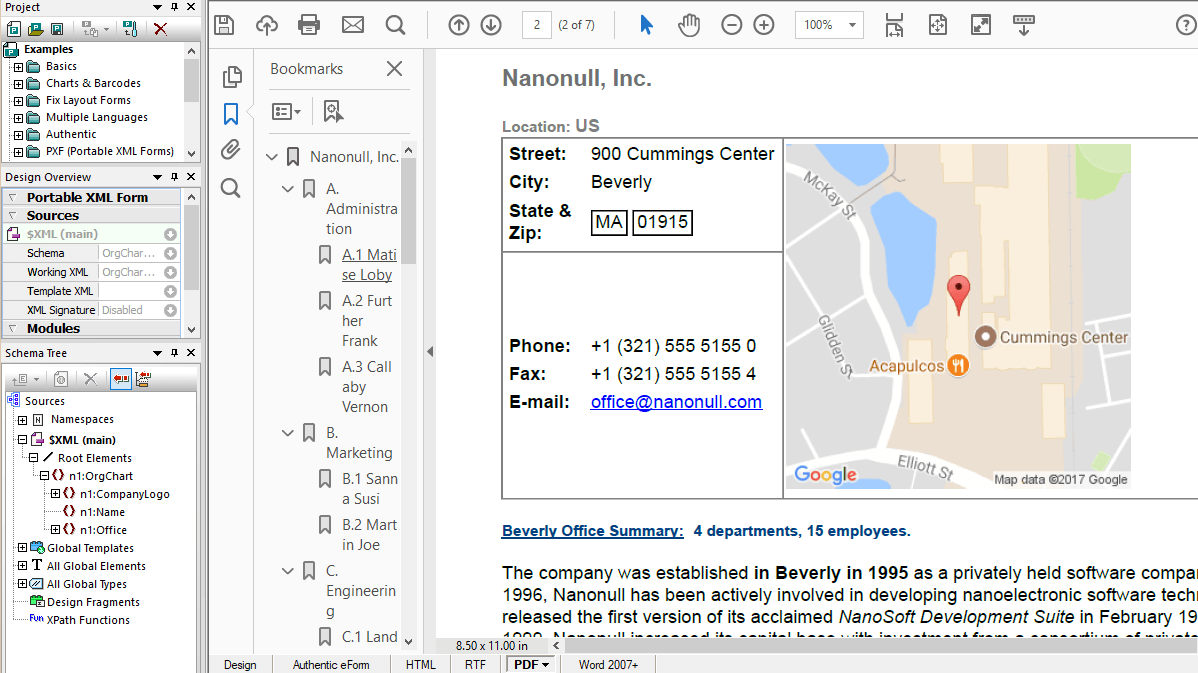
PDF BookmarksPDF bookmarks are navigational links that are displayed in PDF reader applications (such as Adobe Reader). They generally reflect the structure of the PDF document and allow you to navigate to different document sections.
StyleVision gives you the flexibility to define the structure of a document's PDF Bookmarks. By default, all the tables of contents (TOCs) in your document will also be displayed as PDF bookmarks. If you wish to set up PDF bookmarks that are different from the TOC structure, you can use the PDF bookmarks feature for customization. If you create PDF bookmarks, these override the TOC settings and become the settings adopted for the document's PDF bookmarks. To create PDF bookmarks, choose the Add PDF Bookmark Tree command from the Add Header/Footer menu in your Initial Document Section. You will then be able to drag nodes from the Schema Tree to populate your PDF bookmarks.
Re-use Existing XSLTIf you already have written XSLT code or have inherited a project where some of the work has already been done, you can easily use StyleVision's visual design interface to tweak, augment, or completely redesign HTML or PDF output. See our Re-use Existing XSLT page for more information on this feature. CSSStyleVision supports advanced styling functionality for building PDF pages, including support for CSS styles. You can add precise visual styling rules to your designs using built in CSS styles, and you can import your own CSS documents to leverage work you’ve already completed. Some CSS styles, such as those for combo-boxes and other HTML-specific components may not, by their nature, be applicable to paged media output. When such styles are used, a comment is displayed to indicate that a style may render a bit differently in your HTML and PDF output files. In these cases, the paged media will use a suitable print rendition of the effect. StyleVision also allows you to specifiy output-dependent conditions for fine-tuning the output to different media when necessary, for instance to hyperlink text in HTML output but print the actual URL in the corresponding PDF file. Advanced Stylesheet FunctionsStylesheets designed in StyleVision support advanced functionality such as conditional templates, auto-calculations, business logic validation, sorting data on output, and much more. Read more about advanced stylesheet functions. Multi-channel PublishingThe StyleVision visual, drag-and-drop design approach allows you to create standards-conformant transformation stylesheets and rich PDF output in minutes – a process that can take hours when performed manually. As you’re creating your design, the resulting XSL:FO stylesheet is auto-generated along with the PDF output, both which can be viewed by clicking on the Preview PDF tab in the design window.
In addition to the XSL:FO stylesheet for PDF and the associated output, StyleVision also simultaneously generates HTML, RTF, and Word 2007+ output, plus the associated stylesheets, and an Authentic eForm. These stylesheets and output files are all generated based on the single design you create, and you can save the standards-conformant stylesheets and output files separately at any time.
Find out more on the Multi-channel Publishing page. The ability to produce all these stylesheets and output formats based on a single design makes StyleVision® 2012 the perfect tool for publishing your XML, XBRL, and database data in multiple media formats - including PDF - quickly and easily. Download a free 30-day trial of StyleVision. |
| |||||||||||||||||||||||||
| Company | Legal | Press | Partners | Careers | Sitemap | Contact Us | Altova Blog | Mobile | Full Site | |||
|