![]() |
![]() | ![]() | ![]() | HL7 Tools from Altova
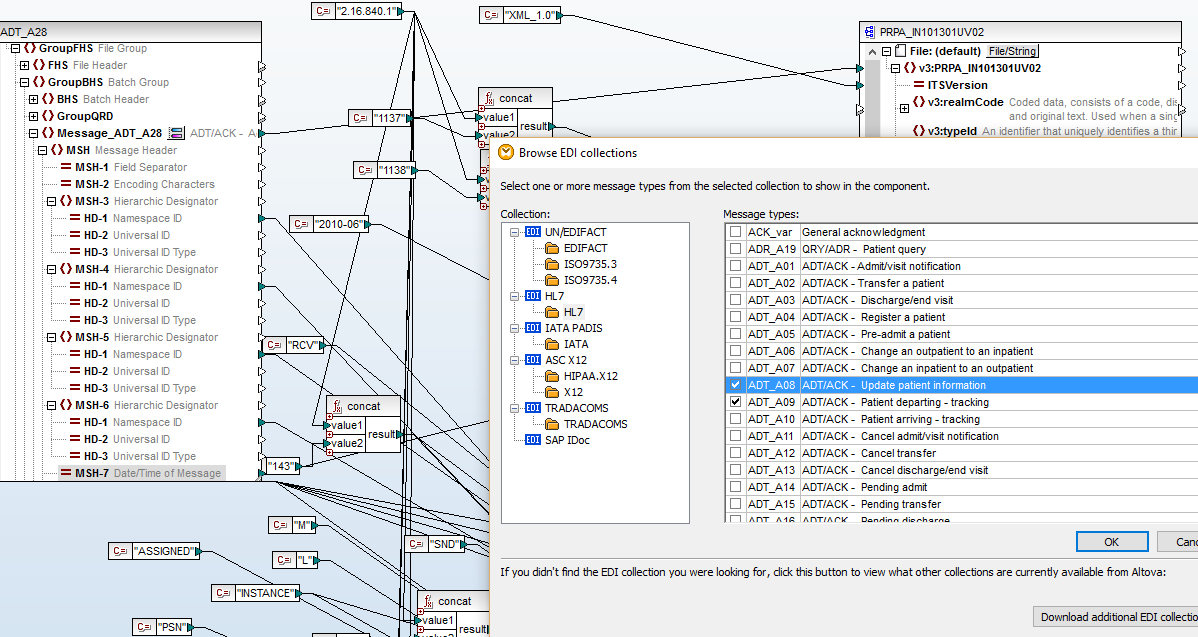
What is Electronic Healthcare Data?Electronic data and ecommerce have revolutionized the way business is conducted in many industries, with legacy EDI formats that predate even most database formats, and XBRL for financial reporting, which, despite its long history has exploded across the globe since the SEC mandate on December 17, 2008. The healthcare industry also seems poised to increase the adoption of electronic transmission standards to promote accuracy, transparency, and processing speed across disparate information systems. Health Level 7 (HL7)HL7 refers to both a standards organization and the set of healthcare messaging standards that it creates. Founded in 1987 to create a set of standards for hospital information systems (HIS), HL7 has expanded its reach to the creation of international standards that transgress hospitals to address clinical and administrative data in healthcare domains such as pharmaceutical, medical device, and insurance transactions. There are already a large number of countries that have mandated the use of HL7 for the transmission of healthcare data and there is an expectation that HL7 will become a part of the United State's Health Insurance Portability and Accountability Act (HIPAA) in the future. For the large number of international healthcare organizations that are embracing the electronic transmission of healthcare data, there remain some formidable challenges. Though some compliance regulations specify the newer, XML-based HL7 v3.x, there are many jurisdictions that still need to update their legacy systems to handle this format, and many that even have multiple disparate data formats in the same system. In the US, for example, many legacy HISs employ HL7 EDI messages alongside HIPAA X12N messages. Though these formats have quite a lot in common, syntactically speaking, they are by no means interoperable and must be mapped on-the-fly to create a dynamic workflow for managing healthcare transactions. Of course, the introduction of the XML-based HL7 v3.x adds EDI/XML mapping to the complication of mapping data from EDI to EDI. HL7 MappingAltova MapForce is an any-to-any graphical data mapping tool that supports mapping HL7 data, in its legacy EDI or newer XML-based format, to and from XML, databases, flat files, other EDI formats, and Web services. Mappings are implemented by simply importing the necessary data structures (MapForce ships with configuration files for the latest EDI standards and offers the full set of past and present HL7 standards as a free download on its Web site) and dragging lines to connect nodes. A built-in function library lets you add advanced data filters and functions to further manipulate the output data. MapForce can also facilitate the automation of your HL7 transaction workflow through code generation in Java, C#, or C++ and an accessible command line interface. Additional support for mapping HL7 data to and from Web services gives healthcare organizations the ability to meet new technology challenges and changing enterprise infrastructures as they unfold within internal and external provider domains. The example below shows a simple mapping updating an HL7 v2.6 message to v3.x. Because we have assigned a sample file to the input structure, we can simply click the Output tab to show the result of our mapping.
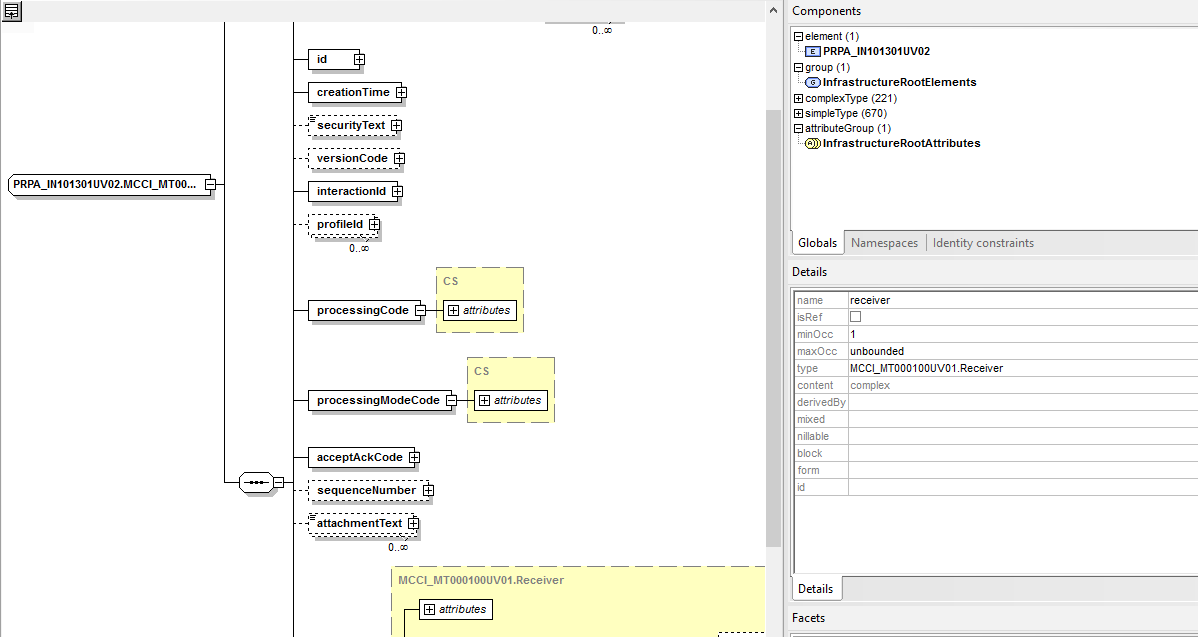
MapForce can also be used to map HL7 data to and from data storage, presentation, and transmission formats including XML, databases, flat files, Excel 2007+, and Web services. For more information on mapping EDI formats in MapForce, see the EDI Mapping Tools page in the Solutions Center. HL7 Editing, Analysis, & ValidationIt is often necessary to have a comprehensive tool to edit, analyze, and validate HL7 transactions. As the leading XML editor, Altova XMLSpy is a powerful development tool that offers unique efficiency enhancements for working with HL7 v3.x data. XMLSpy offers several different unique and easy-to-use graphical views for editing and analyzing HL7 XML data, with additional support from entry helpers, syntax coloring, and autocompletion to help even the most novice XML user make the leap from managing HL7 messages in EDI to XML. The screenshot below shows an HL7 v 3.x XML Schema in XMLSpy's graphical schema editor, an advanced visual interface for viewing and analyzing the structure and syntax requirements of XML data.
XMLSpy offers a broad range of advanced features for working with any variety of XML data and XML technologies from initial conception and data modeling to live deployment on any system, platform, or medium.
* “HL7,” and “Health Level Seven” are registered trademarks of Health Level Seven, Inc. | ![]() |
![]() | ![]() | ||||||||||||||||||||||
| Company | Legal | Press | Partners | Careers | Sitemap | Contact Us | Altova Blog | |||
|