---
title: The XML Framework Behind an Emmy Award
date: 2026-09-25
categories:
- development
- xml
- case-study
tags:
description: Emmy-winning XML — How Craig Seidel used Altova XMLSpy and DiffDog to build MDDF, the metadata standard behaind Disney+, Prime Video, and HBO Max content.
---
Status: #blog
Tags: #case-study
Categories: [development](/blog/category/development.md) | [xml](/blog/category/xml.md)
# The XML Framework Behind an Emmy Award
### An Altova Case Study
*How Craig Seidel used Altova XMLSpy and DiffDog to build the MovieLabs Digital Distribution Framework, the metadata standard powering streaming for every major Hollywood studio*
## Overview
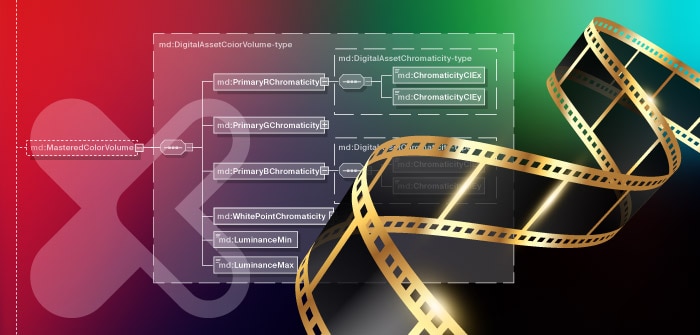
When the Television Academy presented its 76th Engineering, Science & Technology Emmy Awards in October 2024, [one of the statuettes went to Craig Seidel](https://www.televisionacademy.com/photo/56490/view) for the development of the MovieLabs Digital Distribution Framework (MDDF). MDDF is the suite of specifications that defines how movie and television content, metadata, and licensing information flow between studios, service providers, and the streaming platforms consumers use every day.
MDDF is used by every major Hollywood studio and all major content service providers, and it underpins the digital supply chains of services including Disney+, Amazon Prime Video, and HBO Max. At its core, MDDF is XML: every specification in the framework is defined by XML Schemas that were developed, refined, and documented over more than 15 years using Altova XMLSpy and Altova DiffDog.
Seidel spent 14 years at Motion Picture Laboratories (MovieLabs), the technology research lab founded by the major Hollywood studios, where he was Senior Vice President of Technology. He went on to serve as Chief Technology Officer at Pixelogic Media. A long-time Altova customer, Seidel has relied on Altova tools from the framework's very first schema through its most recent releases.
## The Challenge: A Digital Supply Chain Without Standard
In 2008, digital distribution of movies and television was in its infancy. Streaming as we know it did not yet exist; the business revolved around digital downloads. But even that early market exposed a fundamental problem: there was no common language for describing content. Every studio, retailer, and service provider exchanged titles, artwork, ratings, cast and crew information, and licensing terms in its own ad hoc formats, which often amounted to manually maintained spreadsheets and email attachments.
The major studios tasked MovieLabs with leading several initiatives to improve consumer distribution and supply chains. Working in collaboration with the studios and a range of content distributors, Seidel set out to define shared, machine-readable metadata specifications and practices to support the distribution of entertainment content. The effort produced its first published specification, Common Metadata, in 2010.
Over time, that single document grew into a coordinated collection of specifications — the [MovieLabs Digital Distribution Framework](https://www.movielabs.com/md/) — covering avails (licensing terms), descriptive and technical metadata, asset ordering, delivery and status, bonus content, workflows, and APIs.
The technical requirements were demanding. The framework had to model an entire industry's worth of complexity, including hundreds of interrelated data types describing everything from audio configurations to content ratings systems across dozens of countries, while remaining precise enough for fully automated, machine-to-machine exchange. And because the goal was industry-wide adoption, the schemas had to be rigorously documented, versioned carefully, and able to evolve over many releases without breaking the systems that depended on them.
## The Solution: Industry Standards Built in XML with Altova Tools
XML was the natural foundation: it offered strong schema validation, mature tooling, and the expressiveness to model deeply structured entertainment metadata in a standardized way. For designing and maintaining the schemas themselves, Seidel turned to Altova XMLSpy.
> **_“The schemas are the heart of MDDF: they are the contract between everyone in the supply chain. XMLSpy's graphical XSD editor let us design and evolve hundreds of complex types while keeping the whole model understandable. We could see the structure, not just the angle brackets.”_** — Craig Seidel
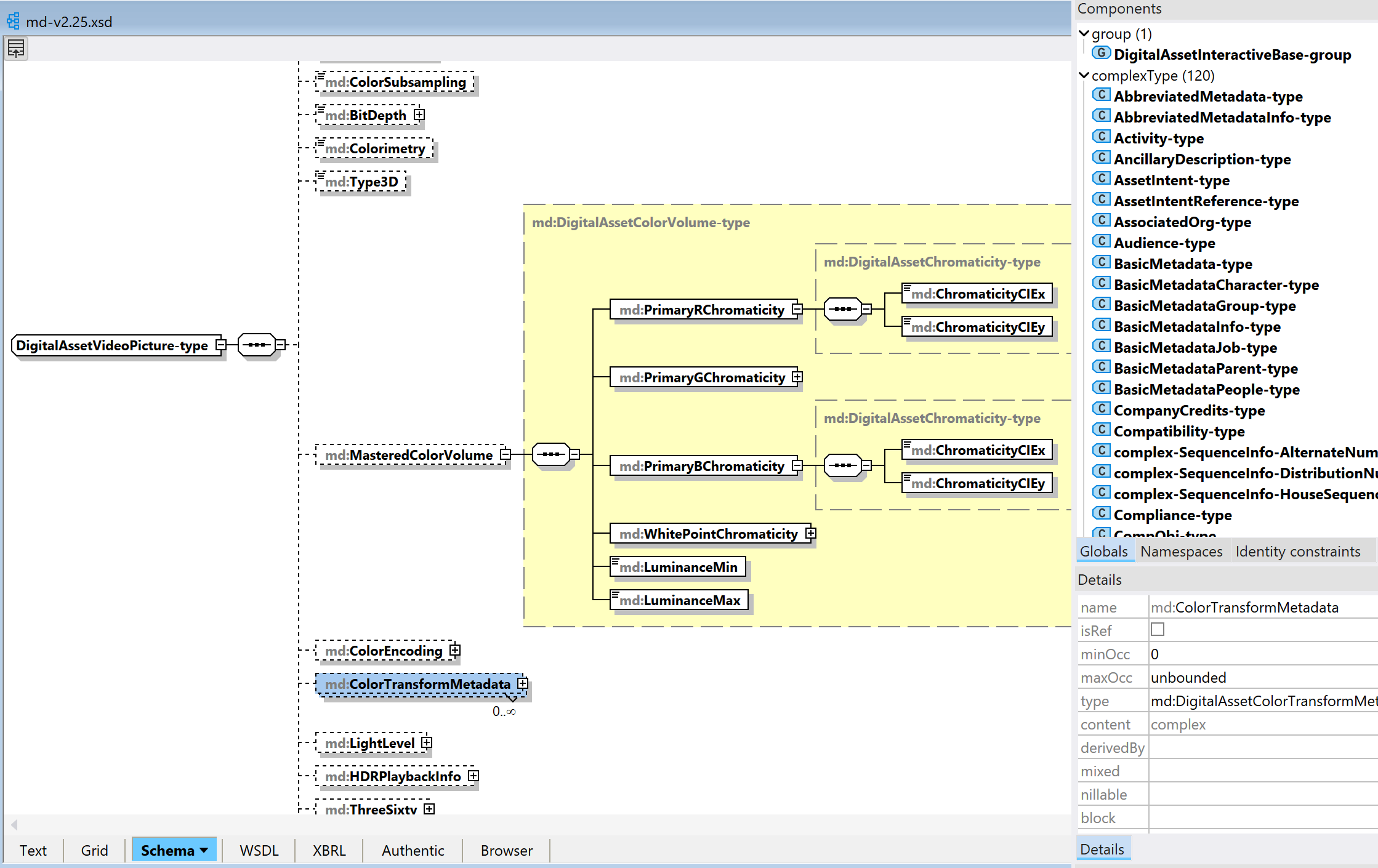
Today the framework's core Common Metadata schema alone defines more than 200 complex types and over 100 simple types, spanning descriptive metadata, technical metadata for video, audio, and subtitles, people and organizations, and rating systems worldwide. XMLSpy's [graphical XML Schema editor](https://www.altova.com/xmlspy-xml-editor/xsd-editor) made it possible to develop and refactor this model release after release, while its validation engine ensured that every published schema, and the sample XML that accompanies it, was correct.
Versioning was equally critical. MDDF specifications are living standards: Common Metadata has advanced through numerous releases, most recently version 2.25. Because studios and platforms build production systems against specific schema versions, every change between releases has to be deliberate, documented, and reviewed. That is where DiffDog, Altova’s [XML-aware diff/merge tool](https://www.altova.com/diffdog), became indispensable.
> **_“Each specification is a combination of the written document and the XML Schema, and the two have to match. I use DiffDog to reconcile changes in the schemas with changes in the documents. It’s helped me catch countless errors prior to publication._**— Craig Seidel
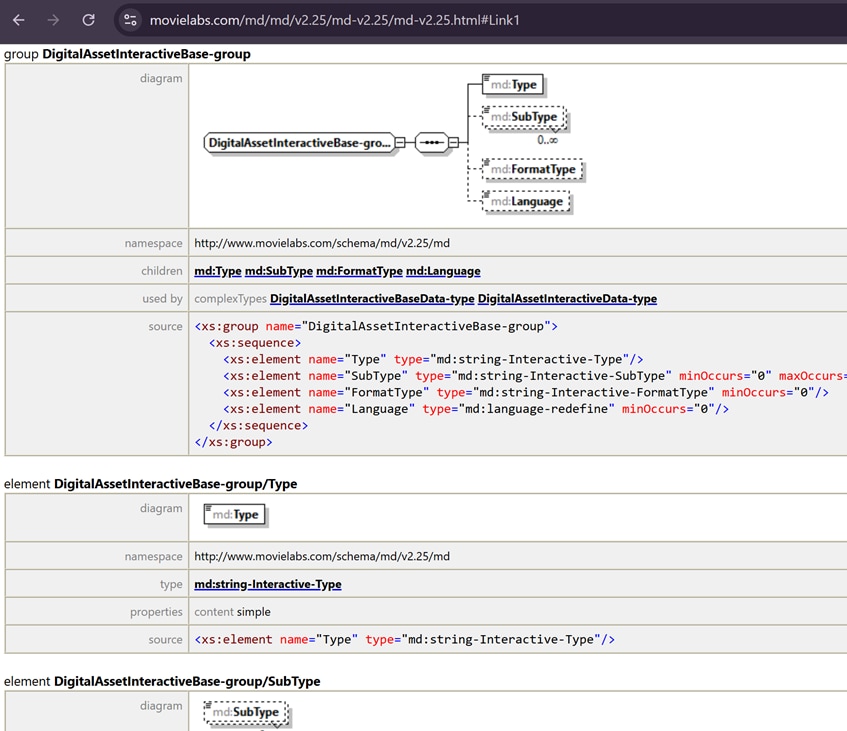
Documentation completed the picture. Alongside each specification PDF, MovieLabs publishes browsable HTML schema reference documentation generated by XMLSpy — complete with content-model diagrams, property tables, and source excerpts for every type. For implementers at studios, service providers, and platforms, this generated documentation is a primary reference for building MDDF-compliant systems.
From the start, the team made a deliberate strategic choice: the specifications, schemas, and documentation are all published free of charge, with no restrictions, under a Creative Commons license.
> **_“We were very intentional about making everything available to anyone, free of charge and with no restrictions. The idea was to make adoption as easy and painless as possible — and it worked.”_** — Craig Seidel
# The Results: An Industry Standard — and an Emmy
What began as a download-era metadata project was already in place when the industry turned to streaming, and it became the foundation the streaming era was built on. MDDF is now used by all major studios and all major content service providers, and it powers content distribution for services including Disney+, Amazon Prime Video, and HBO Max. Structured, validated XML replaced the spreadsheets and emails of the early digital supply chain, enabling automation, reducing costs, and supporting everything from full localization to accessibility-focused assets across global platforms.
On October 23, 2024, the Television Academy recognized that impact, [honoring Seidel with an Engineering, Science & Technology Emmy Award](https://www.televisionacademy.com/features/news/awards-news/76th-engineering-240903) for the development of the MovieLabs Digital Distribution Framework at a ceremony at the Saban Media Center in North Hollywood.
> **_“The Emmy recognizes what the whole industry accomplished together. We built a common language for digital entertainment, and Altova's tools were with us at every step — from the first schema we designed in XMLSpy in the early days to the releases we publish today.”_** — Craig Seidel
Every day, when viewers around the world browse a streaming catalog, see a title's artwork and description, or press play on a localized version of a film, MDDF's Emmy-winning XML framework is working behind the scenes, designed, compared, validated, and documented with Altova software.